AI Automation Agency: What to Sell, Who to Sell It To and How to Deliver
An AI automation agency sells businesses working systems, such as chatbots, voice agents, outreach support and reporting, and charges a build fee plus a monthly retainer to keep them running. The ones that last focus on one type of client, deliver from a library of reusable tools, and win work by showing something useful rather than by mass outreach.
This guide is for new and existing agency owners, freelancers and anyone adding AI services, from beginner to expert. You don’t need to write code.
This guide is part of the course AI Agency v2. AI Agency v2 is our full AI agency course, built around eighteen Claude Projects you use in your own agency first and then deliver to clients.
See the course →Why most AI agencies stall
Most new AI agencies sell one-off builds. A chatbot here, an automation there. Each project ends at handover, the relationship ends with it, and the next client starts from scratch.
Three things keep them stuck:
- Selling builds instead of a system. Revenue resets every time a project finishes.
- Billing by the hour. AI makes the work faster, so hourly pricing punishes the very thing you’re selling.
- Selling “AI” instead of a result. Owners don’t buy a model. They buy fewer missed enquiries or less time on admin.
The fix is to build a set of tools once, run your own agency on them, and then deploy the same tools to every client on a retainer.
What an AI automation agency should sell
Six services cover most of the demand. You don’t need all six. Lead with one and add others once the first is working for a client.
- AI chatbots. The usual starting offer: small enough to say yes to quickly, and a way into a bigger relationship.
- Voice AI agents. Inbound reception, call qualification, reminders and reactivating old customers.
- Outbound support. Research and qualification help for a client’s own sales team, built on a researched list rather than volume.
- AI advertising. Faster ad variations and creative briefs, with a person checking every one.
- Ops and analytics. Help a business see where its time and money go, then automate the worst of it.
- Vertical products. One tool built for one niche, sold to many businesses in it.
Structure every deal in three lines: a build fee for delivery, a monthly retainer for monitoring and improvement, and usage costs passed through visibly in the proposal so model and platform fees never eat your margin.
Who to sell it to
Pick one niche where the work is repetitive, enquiries arrive regularly, the owner can approve a small build alone, and you can list the businesses by name. An AI automation agency with one niche reuses the same tools, the same demo and the same proposal, so each client is faster to deliver than the last.
Getting those first clients works the same way as for any agency: a clear niche, value first, researched personal messages and warm follow-up. Our guide to client acquisition for agencies covers that path in full.
How to deliver, step by step
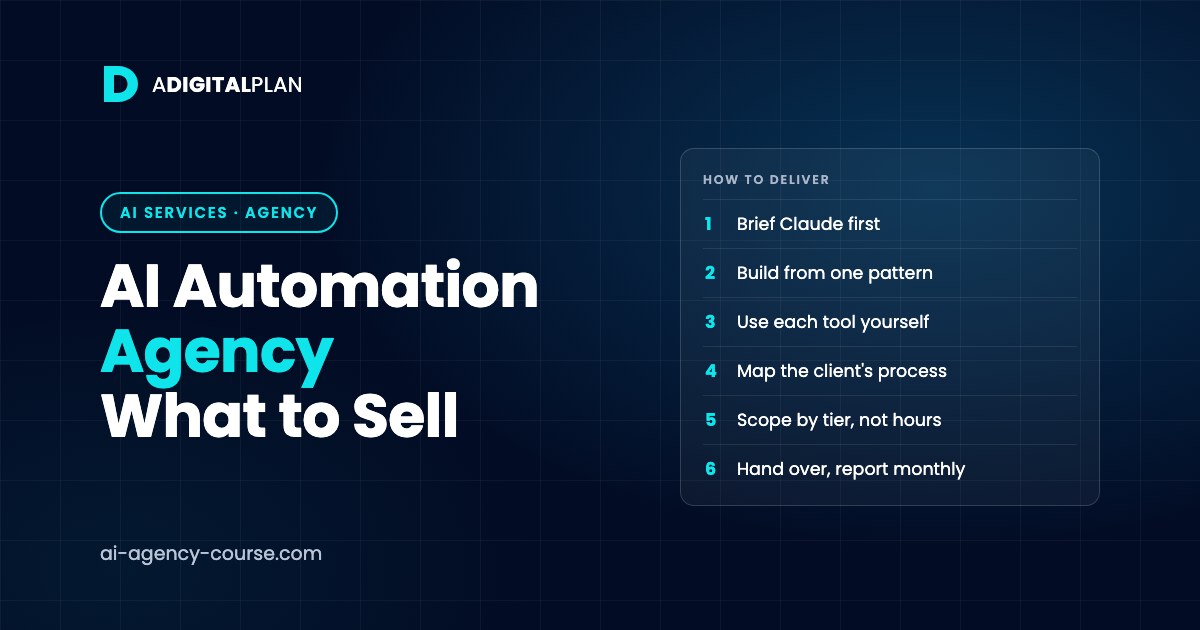
- Brief Claude on your agency first. Your voice, services, pricing approach and ideal client, saved as knowledge in a Claude Project.
- Build every tool from the same pattern. A Claude Project, a master system prompt and knowledge files. The second tool is faster than the first.
- Use each tool on your own agency. Proposals, onboarding packs, status reports. Internal use is free product testing.
- Map the client’s process before scoping. Find the repetitive steps on the discovery call, in their words.
- Scope by tier, not by hours. Write what the build does and what it doesn’t.
- Hand over tested and documented, then report monthly on what the system did. The report is what sells the retainer internally.
If a tool touches customer data, check the data protection and marketing rules for your client’s country. Official guidance, such as the ICO in the UK, is the place to start.
Two prompts to start with. Square brackets mark what only you can fill in.
I run an AI automation agency for [niche]. Here is how a typical client in this niche handles [process, for example new enquiries] today, step by step: [your process notes from the discovery call].

Identify the steps that are repetitive, rule-based or slow. For each, suggest whether a chatbot, an automation or a Claude-based tool fits best, what the client would need to give us, and what could go wrong. Flag anything that touches personal data so I can check the rules.
Write a one-page scope for [client name] covering [chosen tool]. Include: what it does, what it does not do, what the client provides, how we test it before handover, what the monthly retainer covers, and how usage costs are shown. Use the client's own words from these call notes: [your call notes].
Worked example (fictional demo)
Northgate Lettings is a fictional demo business, not a real client. It’s a small letting agency that misses enquiries in the evening and at weekends.
The agency leads with one chatbot: it answers common questions about listed properties from the letting agent’s own information and offers viewing slots. Once that is running, it adds an automation that sends viewing reminders and logs each enquiry in the client’s existing system.
The proposal has three lines: the build, a monthly retainer for monitoring, updates and a short monthly report, and usage costs passed through. The monthly report shows how many enquiries the bot handled and which questions it couldn’t answer, so the client can see the system working.
Common mistakes
- Offering every service to every type of business.
- Building tools for no one before talking to a prospect.
- Pricing by the hour.
- Hiding usage costs until the first invoice.
- Handing over without testing or documentation.
- Skipping the monthly report, so the client can’t see what they pay for.
Learn the full model: AI Agency v2
AI Agency v2 is the full course for anyone working out how to start an AI automation agency or rebuilding an existing one around AI. It has nine sections, from foundations to scaling, with eighteen Tool Master Documents holding the exact prompt setups, pricing and packaging playbooks for all six services, and the full client lifecycle from acquisition to retention. A week-by-week implementation plan has you building and selling in parallel, with a selling day every week.
You finish with the tool library built as Claude Projects, your niche, offer and ideal client defined, services packaged into tiers, and onboarding, delivery and reporting running on SOPs you could train someone else on.
FAQ
Do I need to code to run an AI automation agency?
No. The tools in the course are built with Claude and no-code platforms, configured with plain-English prompts and templates. If you can follow an SOP, you can build them.
Which service should I start with?
Usually a chatbot. It’s quick for an owner to understand and approve, and it opens the door to the other services once it is working.
Is the market too crowded?
Parts of it are. Picking one niche and selling a result in that niche’s own language is what separates you from agencies selling generic “AI”.