AI Automation Course for Agency Owners: Where to Start
If you’re choosing an AI automation course as an agency owner, start with one that ends in one niche, one offer and one working build, not a tour of every tool. Look for a course that has you set up Claude on your own business first, build a chatbot and an automation you can show, and finish by sending real messages to a short list of prospects.
This guide is for agency owners, freelancers and complete newcomers who want to sell AI services, from beginner to expert. You don’t need to code.
This guide is part of the course AI Agency: Foundation Course. Our AI Agency: Foundation Course is a short AI automation course for complete beginners that follows exactly this path.
See the course →Why most people learning AI automation never sell anything
Most people learning AI automation collect tools. They watch videos on five platforms, build a demo for nobody in particular, and never quite get to the part where a business pays them.
The problem isn’t skill. It’s the shape of the learning:
- Tools before a niche. Without a market in mind, every build is a guess.
- Watching instead of building. You can’t show a prospect a video you watched.
- No offer. “I do AI automation” gives a business owner nothing to say yes to.
- No plan to sell. The course ends and the outreach never starts.
It also helps to see the business clearly. You don’t build AI from scratch. You fit it. You import a proven template, customise it for one business, hand it over properly and charge monthly to keep it running. That’s a service you can learn.
What to look for in an AI automation course
Judge a course by what’s finished at the end, not by how many tools it mentions. A good one:
- Has you set up Claude with your business, offer and niche before anything else.
- Makes you choose and score one niche before you build.
- Gets you to write one priced offer, with what’s included and what isn’t.
- Has you build a working chatbot and a working automation, not just watch them.
- Covers handover, testing and what a monthly retainer includes.
- Ends with a dated plan that puts real outreach in front of real prospects.
- Lets you work on free tiers until a client is paying for the software.
If you want to learn AI for business rather than for its own sake, that checklist matters more than any tool list.
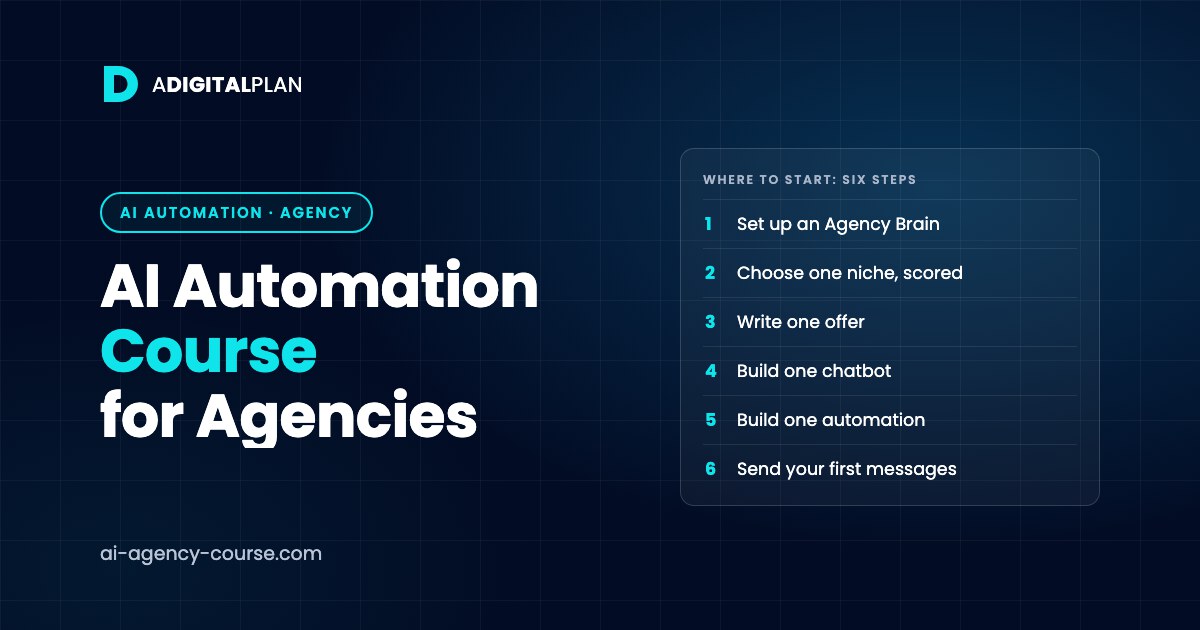
Where to start: six steps
- Set up an Agency Brain in Claude. One Claude Project holding three things: you, your offer and your niche. Every prompt after this answers as your agency.
- Choose one niche, scored. Pick a market where the work is repetitive and you can list the businesses. If you come from social media work, our list of the best SMMA niches is a useful shortlist to score.
- Write one offer. What you build, what’s included, what’s excluded, the build fee and the monthly retainer. Keep it short enough to say out loud.
- Build one chatbot. Start from a template, customise it for your niche, test it and write the handover document.
- Build one automation end to end in a no-code tool such as Make.com or n8n.
- Send your first messages. Build a short, researched list, send personal messages that mention something specific about each business, and use your demo bot on the call.
Two prompts to start with. Square brackets mark what only you can fill in.
Interview me to set up my Agency Brain. Ask me one question at a time, up to twenty in total, about three things: me (background, how I work, how I write), my offer (what I sell, what is included, what is not, what it costs), and my niche (who I sell to, where their time goes, the words they use).

Then write three short documents, one per pillar, that I can save as knowledge in a Claude Project. Where I have not decided something yet, write [TO DECIDE] rather than guessing.
Using my Agency Brain, score these three niches for a first AI automation offer: [niche 1], [niche 2], [niche 3].

For each, rate 1 to 5: how repetitive the work is, how easy the businesses are to list, whether owners can approve a small build themselves, and how well my background fits. Explain each score in one line and recommend one.
Worked example (fictional demo)
Sam is a fictional demo, not a real agency owner. He runs a two-person social media agency for independent gyms and wants to add AI services.
His Agency Brain records his background, his voice and the words gym owners use, such as “trial no-shows” and “front desk is swamped”. He scores three niches and gyms win easily, because he already knows them and can list them.
His offer is one chatbot that answers membership questions and books trial classes, plus one automation that sends trial reminders and adds each booking to the gym’s existing system. He builds both on free tiers, tests them on a demo gym, and offers them first to his existing clients, who already trust him.
Common mistakes
- Learning five platforms before choosing a niche.
- Building a demo that doesn’t match any real business.
- Paying for tools before a client is covering them.
- Handing over a build with no testing checklist or documentation.
- Pricing as a one-off with no retainer for monitoring and updates.
- Finishing the course and never sending a message.
Start with the Foundation Course
AI Agency: Foundation Course is the full course for anyone who wants to start an AI agency from zero. It has 28 short lessons in eight sections and twelve downloads you keep: the Agency Brain starter pack, a twelve-prompt library, a niche scorecard, an offer one-pager, a chatbot type matrix, an importable bot flow and Make.com blueprint, a handover checklist, a price band card and ROI calculator, a demo script, an outreach swipe file and a proposal template.
You finish with a Claude Agency Brain set up for your niche, a scored niche decision, one priced offer, a working chatbot, a working automation, and a day-by-day sprint plan that ends with your first outreach sent.
FAQ
Do I need to code?
No. The course uses templates, drag-and-drop tools and plain-English prompts throughout. If you can fill in a form, you can follow it.
What software do I need to pay for?
You can complete the whole course on free tiers. Paid plans come later, when a client is covering the cost.
What if I have no clients yet?
That’s the starting assumption. The last section is a day-by-day plan for building a list, sending your first messages, running the call and sending the proposal.