How to Start a Marketing Agency When You Hate Cold Calling
If you’re working out how to start a marketing agency without cold calling, the answer is to choose one niche you can actually list, package one clear offer, and win your first clients by giving value first with a short audit of each prospect’s own business. Then run a proper discovery call, send the proposal the same day, and keep every client with honest monthly reports, because referrals are the cheapest clients you will ever get.
This guide is for anyone starting a social media, SEO, PPC, design or email agency, from beginner to expert. You don’t need clients, a portfolio or a team yet.
This guide is part of the course The Agency Blueprint. The Agency Blueprint v2 is our full course on how to start a marketing agency, from a blank page to clients on retainer.
See the course →Why the usual advice fails
The usual advice for new agencies is volume. Buy a list, call or email a hundred businesses a day, and something will stick. Some people make it work. It isn’t the method we teach, and if you hate it, you won’t keep it up long enough to find out.
Volume fails for reasons that have nothing to do with confidence:
- It asks before it gives. A cold call opens with you and asks for time before showing anything.
- It’s general. If you serve “any business”, the prospect has no reason to pick you over the next caller.
- It ignores the real bottleneck. The hard part of an agency is rarely the work. It’s finding clients, pricing without flinching, writing proposals and keeping accounts alive.
A small, researched approach fixes all three. You need fewer prospects, but each one gets something useful from you first.
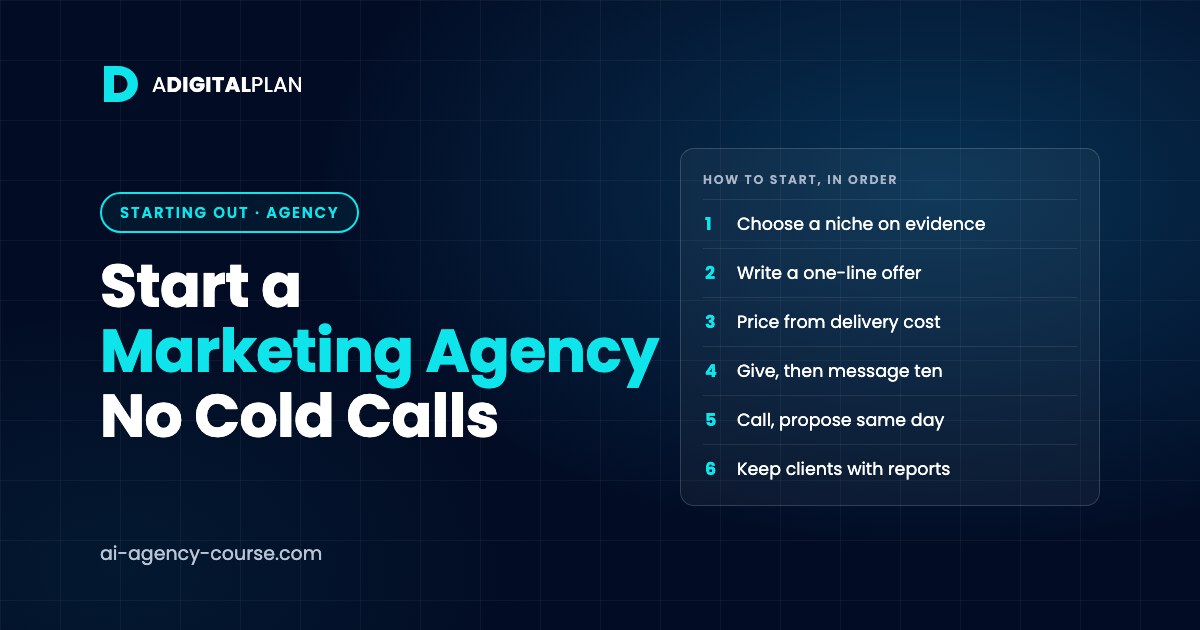
How to start a marketing agency in seven steps
- Choose a niche on evidence. Start with what you have already done: jobs, projects, businesses you’ve helped. Pick a market where you understand the customer and can list at least fifty real businesses. A niche you can list is a niche you can reach without volume.
- Write your offer in one sentence. Who you help, the result they get and how. Turn it into a fixed package rather than open-ended hours.
- Price from delivery cost. Count the hours, including the invisible ones like reporting and calls. Write down what is not included. Then build a simple ladder: an entry offer, a main retainer and a premium option.
- Give before you ask. Pick ten businesses from your list. For each, write a short audit of their own website, Google profile or social accounts. Credit one real strength. Name three problems and what they might cost, with your assumptions shown.
- Send ten researched, personal messages. Address the owner by name, attach or link the audit, and offer one short conversation. Follow up, because replies often come after the first message.
- Run a real discovery call, then propose the same day. Ask, don’t present. Find the problem behind the stated problem and what it costs them. If you propose, build it from their own words and send it that afternoon.
- Keep clients with honest reports. Lead each monthly report with their number, explain falls as plainly as rises, and ask for one thing. Retained clients are where referrals come from.
Alongside this, post helpful content where your niche already gathers, so prospects have seen your name before your message arrives.
Running an AI marketing agency as one person mostly means letting Claude handle the paperwork: audit drafts, proposals from call notes, onboarding packs and reports. You keep the judgement and the research.
Two prompts to start with. Square brackets mark what only you can fill in.
I want to start a marketing agency. Here is everything I have done before, including jobs, projects and businesses I have helped: [your history].

Suggest five niches I could serve, based only on that history. For each one, tell me: could I list at least fifty real businesses in it, do they already pay for marketing, what result they care about most, and what I would still need to learn. Be honest where my history is thin.
Draft a short audit for [owner's name] at [business name], a [type of business] in [town]. Here is what I found on their website, Google profile and social accounts: [your notes].

Credit one genuine strength, at the same length as each problem. Pick three problems and say what each one might cost them, with the assumptions shown. End by offering one short conversation about one of the three. Do not invent any figure.
Worked example (fictional demo)
Maya is a fictional demo, not a real agency owner. She spent two years running social media for a dental practice and helped a friend’s physio clinic with its Google profile.
Her history points to one niche: private health clinics in her region. She lists sixty of them, picks ten with active websites but weak Google profiles, and writes each one a one-page audit. Each audit credits a genuine strength, such as clear pricing, before naming three problems.
She sends ten personal emails over a week and follows up once. On her first discovery call, the owner says the problem is “more followers”, but a few questions in, the real issue is unfilled appointment slots on weekday mornings. Maya sends a proposal that afternoon built around those exact words.
Common mistakes
- Choosing a niche because it sounds profitable, not because you understand it.
- Building a website and logo for weeks before talking to a single prospect.
- Sending one generic audit to everyone.
- Discounting at the first hesitation instead of adjusting scope.
- Writing the proposal days after the call, from six bullet points.
- Treating the monthly report as admin instead of the thing that keeps the client.
The full course: The Agency Blueprint v2
For the client-winning side in more depth, our guide to getting your first SMMA clients walks through it for social media agencies.
The Agency Blueprint v2 is the full course, built in order so each stage produces what the next one needs. It covers choosing a niche and ideal client, productising your services into a priced value ladder, a free-audit lead funnel, discovery calls, proposals assembled from your own call notes, onboarding, reporting, quarterly reviews and building a small contractor team. There are separate playbooks for SMMA, SEO and PPC, design and UX, email marketing and lead generation.
You finish with the working parts of an agency rather than a folder of notes. If you’ve been searching for how to start a digital marketing agency without cold calling, this is the full path we teach.
FAQ
Can I start a marketing agency with no clients or portfolio?
Yes. The audit is your portfolio at the start. A specific, useful audit of a prospect’s own business shows what you can do better than a case study from a different industry.
Should I pick one niche or keep my options open?
Pick one. You can change later, but a single niche means every audit, message and proposal gets better than the last instead of starting from scratch.
Do I need to be good with AI to do this?
No. You need to be able to describe your business and your client clearly. Claude does the drafting. The research, the honesty and the decisions stay with you.