Discovery Call Questions for Marketing Agencies, with a Simple Script
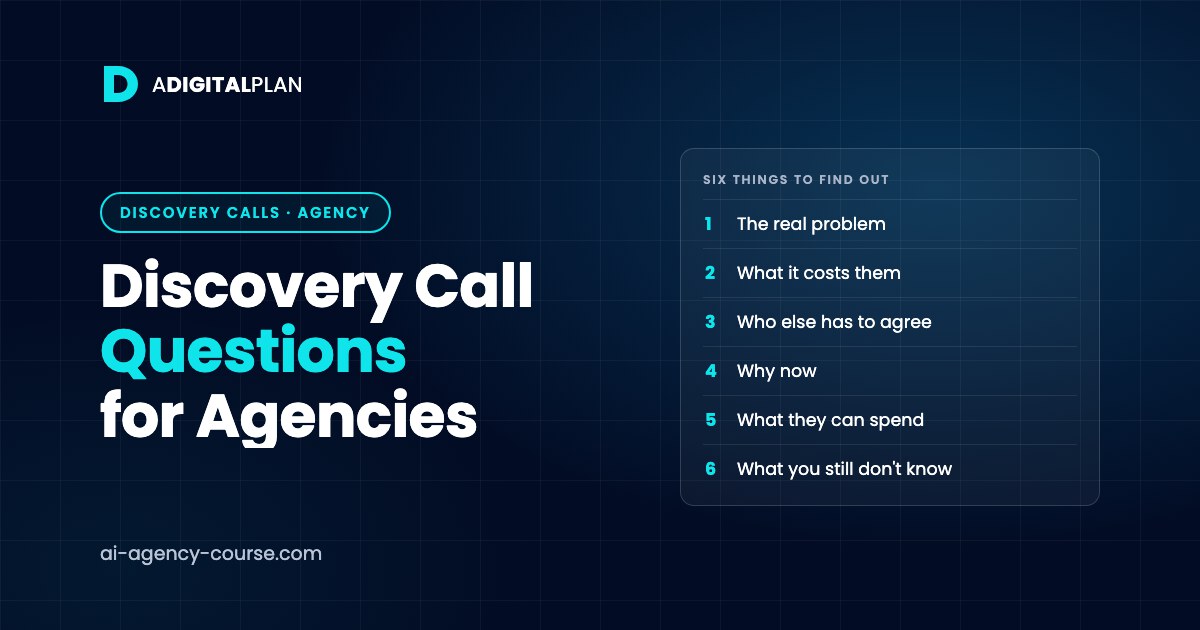
Good discovery call questions find six things: the real problem, what it costs, who else has to agree, why now, what they can spend and what you still do not know. Plan them the day before, let the prospect do most of the talking, and end the call with a decision on whether to propose at all.
This is for SMMA, marketing and AI agency owners, from beginner to expert, whether it is your first sales call or your fiftieth.
This guide is part of the free course Agency AI Discovery Call Kit. The free Agency AI Discovery Call Kit turns your discovery call questions into a plan, structured notes and an honest verdict. It is free, with no card.
Start the free course →Why most discovery calls go fine and produce nothing
A good conversation feels like progress, so nothing gets fixed. Four things go wrong, and none of them is charisma.
- You take the stated problem at face value. They lead with what annoyed them that week. The real problem tends to surface later, once they stop answering and start thinking.
- You never find what it costs them. No cost means no reason to act this quarter, and a proposal into a shrug goes unanswered.
- Somebody else is mentioned once. A partner or co-owner, in passing. That person reads your proposal cold.
- You write the proposal anyway. Because the call felt good. Then you spend a month chasing a polite maybe.
All four are decided before you dial. The call is also the point where our whole approach pays off. We teach agencies to win clients without cold calling or mass outreach: a niche, a give-first audit, a few researched messages. That only works if the calls it produces are run well. For the full path, read our guide to customer acquisition for agencies.
Discovery call questions, grouped by job
Group your questions by what they have to find out, not by topic. Here are fifteen to adapt. Change the wording so they sound like you.
1. The real problem
- What made you look at this now rather than six months ago?
- When it goes wrong, what actually happens?
- What have you already tried, and what happened?
2. What it costs
- If nothing changes for a year, what does that cost you?
- Roughly how many hours a week go on this now?
3. Who else has to agree
- Who else will want a say before anything goes ahead?
- What will they want to see?
4. Why now
- Is there a date, a season or a hire this is tied to?
- What happens if this waits until next year?
5. What they can spend
- What were you planning to do about this if we hadn’t spoken?
- What would that have cost?
- What have you spent on this before?
6. What you still don’t know
- Is there anything I haven’t asked that I should have?
- What would make this a bad fit?
- What’s the best way to follow up with you and whoever else is involved?
Group five is the practical trick. Few people answer a direct budget question honestly, but most will tell you what they were about to spend on the alternative.
A simple discovery call script
- The day before, plan the call. Write the three things you must find out, ranked in case it overruns, and the objections you expect.
- Open with one line, then a question. Who you are in a sentence, then “What made you look at this now?” Aim for the prospect to talk for most of the thirty minutes.
- Write down their words. Their phrases, numbers exactly as said, and a question mark wherever you were not sure.
- Close with a next step and a date. Not “I’ll send something over”.
- Within a few hours, sort your notes and decide. Use the prompt below, then send a recap email under 150 words with one question.
Here are my raw notes from a discovery call with [business name]: [paste notes].
Sort them under six headings: the real problem, what it costs, who else has to agree, why now, what they can spend, what I still don't know.
Keep their exact words separate from my own conclusions.
If something was not said, write "unknown". Do not fill gaps with anything that sounds reasonable.
Then give a verdict: propose now, go back with questions, or walk away, and say why.
The course gives you a fuller discovery call script and six prompts covering the plan, the questions, likely objections, the notes, the recap email and the verdict.
Worked example (fictional demo)
Larkfield Garden Rooms is a fictional builder, invented for this example, talking to a fictional SMMA.
- Stated problem: “Our Instagram is dead.”
- Real problem, about ten minutes in: “Most of our jobs come from one show a year, and if that’s quiet we’re stuck.”
- Cost: they could not give a figure. The notes say “unknown”, and it becomes the recap email’s one question.
- Who else: “my wife does the books”, mentioned once. She will read the proposal.
- What they can spend: they were about to pay for a bigger stand at the show.
- Verdict: go back with questions. No proposal until the cost and the second decision-maker are clear.
Common mistakes
- Spending the first ten minutes on your credentials.
- Solving the problem they led with on the call.
- Asking “what’s your budget?” and believing the answer.
- Letting notes upgrade a hint into a fact. A figure mentioned in passing becomes “the budget”.
- Treating “it went well” as a reason to write the proposal.
What you finish with
The free Agency AI Discovery Call Kit is four short lessons (about thirty-three minutes), six prompts and a recorded demo on a real-shaped call. You finish with a call plan, fifteen questions grouped by job, ranked objections, structured notes with their words and your read kept apart, a list of what the call did not establish, a same-day recap email and a verdict. The notes are the input the free Proposal Generator takes, so a “propose” verdict needs no rewriting. Start with the discovery questions and your next call ends in a decision.
FAQ
How many discovery call questions should I ask?
Prepare about fifteen, grouped by job, but expect to use fewer. The three things you must find out come first, in case the call overruns.
Should I ask about budget on a discovery call?
Ask what they were planning to spend on the alternative instead. It gives you a real figure without the awkward question.
When should I not send a proposal?
When you could not find the cost, the second decision-maker or a reason to act now. Go back with questions, or walk away.