Social Media Management Packages: How to Build Three Tiers That Sell
Social media management packages that sell are built from your real delivery cost, not a competitor’s price page. List every task you do for a client each month, cost it honestly, build the middle tier first, write down what each tier excludes, then set a price band with a margin you chose and a floor you will not go below.
This is for SMMA and social media agency owners, from beginner to expert, including those with no clients yet who want a first price they never have to walk back.
This guide is part of the free course Agency AI Pricing and Packages Builder. The free Agency AI Pricing and Packages Builder turns an honest service list into costed social media management packages with six prompts. It is free, with no card.
Start the free course →Why agency packages stop working in month four
Most pricing is a number somebody hoped for and then defended. It does not fail on day one. It fails a few months in, when onboarding is over, the reactive requests have settled into a rhythm and you are doing hours you never priced. Four causes:
- Anchoring on a competitor. You cannot see their delivery cost, team rates, tools or automation. Their price is the least useful number they have.
- Never counting the invisible work. Onboarding, reporting, the escalation call, the thing you do every Friday out of habit.
- Writing what is included but not what is not. Scope creep is a sentence nobody wrote.
- Discounting at the first hesitation. It tells the client the price was invented.
Packages matter for how you win clients too. We teach agencies to get clients without cold calling or mass outreach, and a clear menu with costed tiers is what lets you send a proposal the same day after a good call. For the steps before pricing, see how to get SMMA clients.
How to build three social media management packages
Work in this order: cost first, boundaries second, price third.
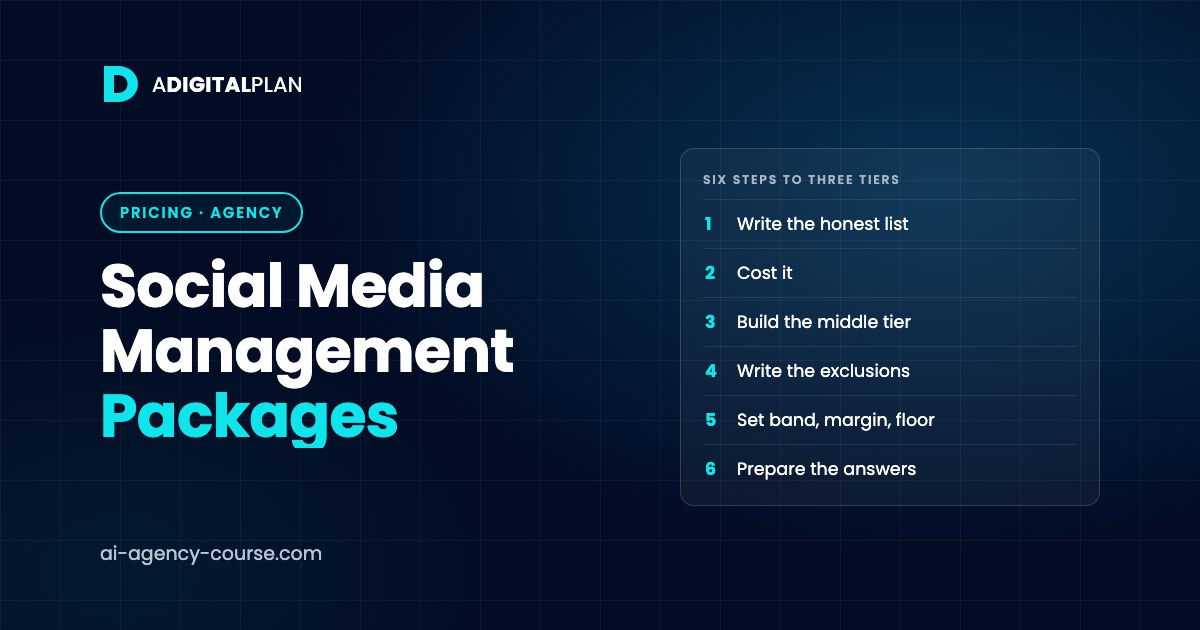
- Write the honest list. Every task you do, or plan to do, for one client in a month. Include the twenty-minute call, the write-up afterwards, the comment replies and the report. If the list feels tedious, it is probably right.
- Cost it. Hours per task, on the pessimistic side, plus tools, plus a slack allowance stated as a percentage. If you have never set an hourly figure, work one back from what you need to earn and how many hours are really billable.
- Build the middle tier first. This is the package you want most clients to buy. Build the smaller and larger tiers around it so the middle is the obvious choice.
- Write the exclusions. For each tier, a few plain sentences on what is not included, that you could read out on a call without sounding defensive.
- Set a price band, a margin and a floor. Show the margin at the bottom and the top of the band. Decide your floor now, not halfway through a negotiation.
- Prepare the answers. An ROI case per tier with the arithmetic shown, and answers to the price objections you expect.
A costing prompt, with square brackets for what only you can supply:
I run a [type of agency]. Here is every task I do for one client in a month, with my honest time estimate for each: [paste list].
My tools cost [monthly tool cost]. I need to earn [target income] and can bill about [billable hours] hours a month.

1. Work out my hourly figure from those numbers, showing the arithmetic.
2. Cost each task, rounding time up, and add a slack allowance as a stated percentage.
3. Name the one task that takes the most hours for the least visible value.
4. Build three tiers starting from the middle one. For each, list what is included and write two or three sentences on what is excluded.
5. Suggest a price band for each tier with the margin at both ends.
Do not use market rates or competitor prices. Use only my numbers.
If the costing comes back comfortable, your list was the tidy version. Add the tasks you left out and run it again. The same steps apply if you sell search: SEO pricing packages need the same honest list, just with different tasks on it.
Worked example (fictional demo)
Saltmarsh Social is a fictional two-person SMMA, invented for this example. Prices are left as placeholders because the point is the structure, not the numbers.
- Starter: one platform, a set number of posts a week, a monthly report. Excludes: replying to comments and messages, paid ads, filming. Price: [band from costing].
- Growth (the middle tier): two platforms, posts plus stories, comment replies during working hours, a monthly report and call. Excludes: paid ads, filming on site, crisis response out of hours. Price: [band from costing].
- Full service: Growth plus paid social management and one filming day a quarter. Excludes: ad spend itself, website changes. Price: [band from costing].
When the owners wrote the honest list, the task that surprised them was the monthly report. It took far longer than they had assumed, so they costed it properly instead of treating it as free.
Common mistakes
- Copying another agency’s three tiers and prices.
- Leaving reporting, onboarding and calls off the cost.
- Listing what is included and nothing that is excluded.
- Making the top tier the one you want to sell.
- Taking ten per cent off the moment someone hesitates. Change the scope, tier or timeline instead.
What you finish with
The free Agency AI Pricing and Packages Builder is four short lessons (about forty-two minutes), six prompts and a recorded demo, with a prompt pack and SOP. You finish with a true monthly cost per client, the task quietly eating your hours, an hourly figure for your own time, three tiers with written exclusions, price bands with margin shown at both ends, a floor, an ROI case per tier and prepared answers to price objections. It works whichever of the common agency pricing models you use, because it starts from your own cost.
FAQ
How many social media management packages should I offer?
Three is a good number: a smaller tier, the middle tier you want most clients to buy, and a larger one. Build the middle first.
Should I put prices on my website?
That is your choice. What matters is that every figure on the menu comes from your own costing, so you can explain it on a call.
What do I do when a client says it is too expensive?
Change the scope, tier or timeline rather than the number. A price with visible arithmetic behind it has those levers; a hoped-for number only has the discount.