Social Media Audit Template That Wins the First Meeting
A social media audit template that wins the first meeting ties every finding to evidence the owner can check, credits one genuine strength, costs three problems with the assumptions shown and ends with one small ask. Spend twenty minutes on the prospect’s public footprint, let Claude score and draft, then send it to the owner by name.
This is for SMMA, social media, marketing and AI agency owners, from beginner to expert. You do not need clients, case studies or an ad budget, just one business you would like to work with.
This guide is part of the free course Agency AI Client Audit Generator. The free Agency AI Client Audit Generator gives you a six-part marketing audit template and the prompts that fill it in. It is free, with no card.
Start the free course →Why most free audits go straight in the bin
A cold email asks before it gives. It opens with you, claims without showing, could go to four hundred other businesses and asks for fifteen minutes of a stranger’s week. An audit turns all four round: you do the work first, so a conversation becomes the natural next step.
But a site scan is not an audit. Owners have seen plenty of automated PDFs: warnings with no business consequence, every section a problem, numbers with no working, written for a marketer and ending in a demo link. That is why the free-audit play has a bad name.
We teach agencies to win clients without cold calling or mass outreach. A short, honest audit for one business is the give-first step in that path. The same idea works for search agencies too; see how to get SEO clients for that side.
The social media audit template
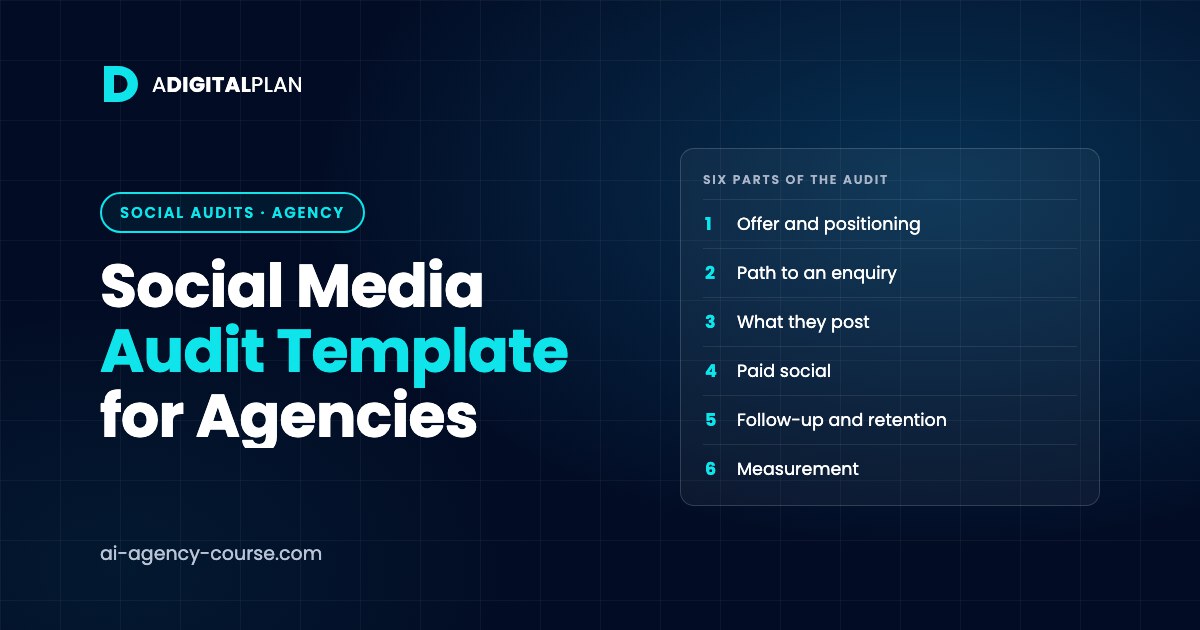
Use six sections, each scored one to five, with the business consequence of a low score written in the owner’s terms.
- Offer and positioning. Could a stranger tell from the profiles what is sold, to whom and why them?
- Path to an enquiry. Bio link, booking button, response to comments and messages. Can attention become an enquiry without friction?
- What they post. Does it build up over time, or is it announcements nobody would save?
- Paid social. Is any spend structured and measured? Mark it “not observable” if you cannot see it.
- Follow-up and retention. Does a follower ever become an email subscriber or a repeat customer?
- Measurement. Could the owner prove any of the above? Is there tracking on the links?
Then add three things that make the rest credible: one genuine strength argued at the same length as the problems, three problems costed in dollars with every assumption printed underneath, and one scoped next step.
How to fill it in
- Do a twenty-minute sweep. Their profiles, recent posts, comments, reviews, website and any ads in public ad libraries. Copy what you see word for word. A summary is already an interpretation.
- Mark the gaps. Anything you could not see is written as “not observable”, never guessed.
- Score and cost with Claude. Use the prompt below.
- Write it to the owner. Plain language, by name, about their business, not your services.
- Send it with a short covering email. Under 120 words, carrying exactly one ask.
The scoring prompt, with square brackets for what only you can supply:
I run a [type of agency]. Here is my evidence sweep on [business name], copied word for word, with the source of each item:
[paste sweep]

Score these six areas from 1 to 5: offer and positioning, path to an enquiry, what they post, paid social, follow-up and retention, measurement.
For every score, quote the evidence behind it.
If there is no evidence for an area, write "not observable". Do not guess.
Name one genuine strength and argue it at the same length as each problem.
Pick the three problems that cost the most. Cost each one in dollars as a formula, and list every assumption underneath so the owner can correct it.
Write for the owner, [owner name], in plain English.
Read the output back against your sweep. Any finding that does not point at something you can read aloud on a call comes out. The course runs this whole social media audit template on a worked prospect first, then in a workshop lesson on one of yours.
Worked example (fictional demo)
Fernway Pilates is a fictional two-studio business, invented for this example. The sweep took twenty minutes and found:
- Strength: class videos filmed by the instructors get far more comments than anything else on the account. That is a real asset, argued at full length.
- Problem one: several comments ask about beginner classes and have no reply. Cost formula: [unanswered enquiries a month] x [share who would book] x [value of a first booking]. Each figure is an assumption for the owner to correct.
- Problem two: the bio link goes to the home page, not the timetable.
- Problem three: no sign-up offered anywhere, so followers never become an email list.
- Paid social: not observable.
- The ask: “Would a twenty-minute call to check my assumptions on the first problem be useful?”
Common mistakes
- Making every section a problem. It shows your motive and the owner stops reading.
- Costing problems without showing the working.
- Filling gaps with guesses. An unmarked guess is the finding they will challenge first.
- Writing to a marketing manager when the owner signs.
- Ending with three options instead of one ask.
- Sending an automated scan and calling it an audit.
What you finish with
The free Agency AI Client Audit Generator is four short lessons (about thirty-five minutes), six prompts and a workshop lesson. You finish with a six-page audit on a real prospect, all six parts scored against evidence, three problems costed in dollars, one strength credited, a covering email with one ask, and a sweep you can repeat on anyone. SEO agencies can use the same structure as an SEO audit template, putting more weight on the website and organic sections.
FAQ
What should a social media audit include?
What is sold and to whom, the path from a post to an enquiry, whether the content builds up, any paid social, follow-up after the first sale, and whether any of it is measured. Add one strength and three costed problems.
Should I send a free audit before the first call?
That is the method we teach. A short audit gives before it asks, so the call becomes a conversation about their business instead of a pitch.
Can Claude do the audit for me?
Claude can score, cost and draft. It cannot look at the business, so the twenty-minute sweep has to be yours.