AI Proposal Generator for Agencies: Send the Proposal the Same Day
An AI proposal generator for agencies works best when it writes from the transcript of the discovery call, not from a template or your memory. Record the call with a free notetaker, paste the transcript and a one-page facts sheet about your agency into Claude, check every claim against what the client said, and send the proposal the same day.
This is for SMMA, marketing, web design and AI agency owners, from beginner to expert.
This guide is part of the free course AI Agency Proposal Generator. The free AI Agency Proposal Generator course shows you how to set up Claude as your AI proposal generator, using a real call transcript as the demo. It is free, with no card.
Start the free course →Why proposals are lost after a good call
Most deals are not lost on price. They are lost in the days after the call, while the proposal waits for the two or three spare hours it takes to write. Four things go wrong between the call and the send.
- You listen, or you write. You cannot capture what someone said and follow what they meant at the same time.
- Six bullets, four days later. The proposal is built from a fragment on the evening you finally have time.
- Their best line is gone. The aside where they diagnosed their own problem never reached your notes.
- So you describe your services. A proposal that describes services is a price list with a cover page.
Fix the first and the other three stop happening. A proposal sent the same day, in the client’s own words, is the step that turns a good call into work. It is part of how we teach agencies to win clients without cold calling or mass outreach: niche, audit, researched messages, a proper discovery call, then this. Web designers can see the earlier steps in our guide on how to get web design clients.
How to set up an AI proposal generator with Claude
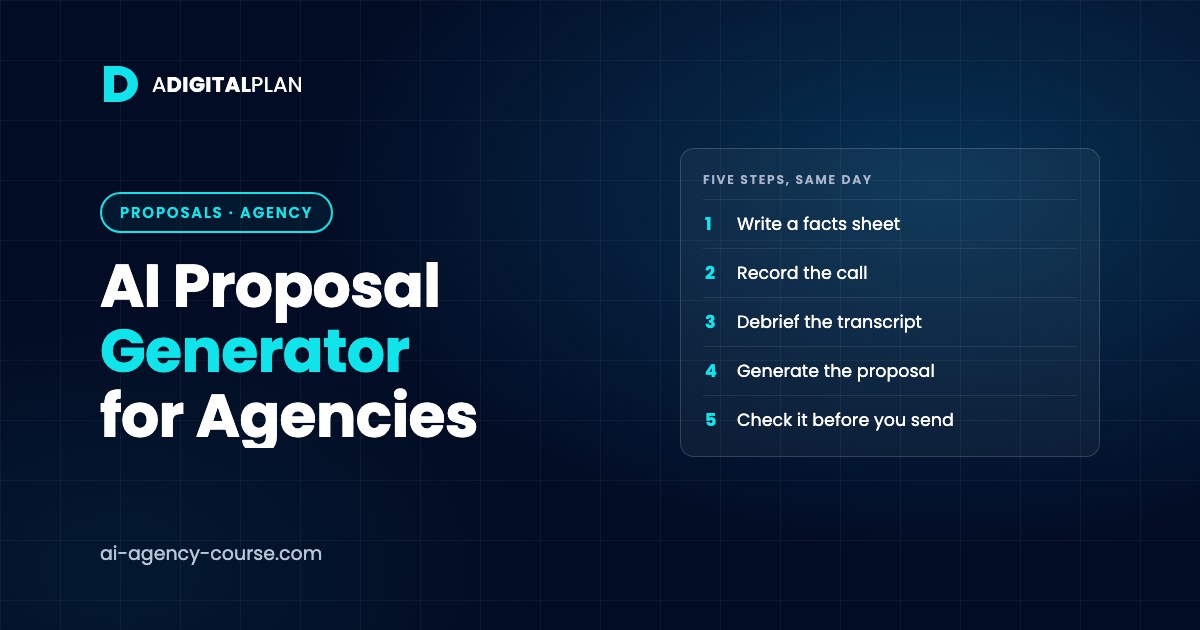
- Write a one-page facts sheet, once. Your services, the problems clients describe out loud, what you deliver, and the price ranges you charge. You paste it in with every transcript from then on.
- Record the call. A free notetaker such as Fathom or Otter can join and transcribe. Tell the client you are recording and check the rules where you are. Make sure the numbers that matter (budget, timeline, volumes) are said out loud.
- Debrief the transcript. Ask Claude for a summary, a list of what you forgot to ask, and the sentence your proposal should open with.
- Generate the proposal. Use the prompt below.
- Check it before you send. Ask Claude to audit every claim against the transcript and flag anything the client never said.
If you already use a marketing proposal template, keep it for layout only. A template gives you the shape and leaves you the hard part: knowing what this client needs. That knowledge was in the call.
The generation prompt. Square brackets are what only you can supply.
Here is my agency facts sheet: [paste facts sheet].
Here is the transcript of a discovery call with [client name]: [paste transcript].

Write a proposal with these parts: opening summary, their situation in their own words, the diagnosis (why the problem is happening, not just what they said), the recommendation and why it follows from the diagnosis, scope with phases and timeline, investment and one next step.
Quote the client where it helps. Price only from the ranges in my facts sheet.
If the right scope costs more than the budget they mentioned, say so. Propose a first stage sized to their budget that delivers something measurable, with the full scope stated at its real cost.
Do not mention any system, figure or goal that is not in the transcript.
Then the check:
Compare this proposal with the transcript. List every claim, figure or system in the proposal that the client did not say, and quote the line it should be based on.
Worked example (fictional demo)
Copperleaf Accountants is a fictional firm and Thistle Digital a fictional agency, both invented for this example. On the call, the partner says lead generation is “up and down”, then adds in passing: “It’s mostly referrals, which is fine until it isn’t.”
- Their situation: new clients arrive in waves, tied to when existing clients happen to recommend them.
- Diagnosis: there is no always-on channel, so enquiries follow referral timing. That came from the aside, which never would have made the notes.
- Budget gap: the partner mentioned a monthly figure lower than the full scope. The proposal states the full scope at its real cost and offers a first stage sized to that figure.
- The check: it flagged one line mentioning a CRM the partner never named. It came out.
Common mistakes
- Writing from notes instead of the transcript.
- Quietly pricing to whatever number the client mentioned.
- Discounting the full scope instead of splitting it into stages.
- Repeating what they told you in tidier sentences. That is a transcript with a price attached, not a diagnosis.
- Skipping the check and sending a claim the client never made.
- Giving three next steps instead of one.
What you finish with
The free AI Agency Proposal Generator is three lessons, six prompts and three SOPs, built around a real call transcript. You finish with a one-page facts sheet, a recording routine, debrief and diagnosis prompts, a generation prompt that writes all eleven parts of a proposal, an honest way to handle a budget gap, and a check that runs before you send. SMMA owners who came looking for a social media proposal template will find the same method works for any service on their facts sheet.
FAQ
Can an AI proposal generator write the whole proposal?
Claude can draft the full document from the transcript and your facts sheet. You still read it, run the check and decide the price.
Do I need special software?
No. A free notetaker for the transcript and Claude for the writing. There is no knowledge base to configure.
What if the client’s budget is lower than the right scope?
State the full scope at its real cost, and offer a first stage sized to their budget that delivers something measurable. Do not discount or quietly cut the scope.