Ideal Client Profile Template for Agencies, Filled In with AI
An ideal client profile template for an agency needs four parts: the market, the trigger that makes them look, the words they use, and the signs that rule a business out. Fill it in from your own work history with Claude, then test it by trying to list two hundred named businesses that fit.
This guide is for SMMA, marketing and AI agency owners, from beginner to expert. It works whether you have ten clients, a few mixed ones or none yet.
This guide is part of the free course Agency AI Niche and ICP Finder. The free Agency AI Niche & ICP Finder course fills in your ideal client profile template with six plain-English prompts. It is free, with no card and lifetime access.
Start the free course →Why most ideal client profiles are useless
Most agency profiles describe a temperament. “Ambitious founder-led businesses.” “Companies that value quality.” “Businesses ready to scale.” None of those can be checked from outside, so none of them can be turned into a list.
A profile you cannot list is a preference, not a market. You cannot write a relevant message to a temperament, and a result for one client tells the next prospect nothing.
The second problem is order: the profile gets written before the niche is chosen, or the niche is picked on aspiration. If nothing in your own history points at that market, you start from zero against specialists. If you have not settled the market yet, first read how to choose a niche for your marketing agency, then come back to this template.
This matters for how we teach agencies to win clients. We do not teach cold calling or mass outreach. The method is a narrow, researched list, an audit that gives before it asks, and personal messages to a few businesses. All of that depends on a profile specific enough to build a list from.
The ideal client profile template, part by part
Each part has a test it must pass.
- Market. The observable thing that decides who is in. A trade, a register, a directory category or a map search. Test: you can name where the list comes from without buying data.
- Trigger. A visible event that makes some of them look this quarter. A new location, a job advert, a launch, a season. Test: you could see it on a public page.
- Their words. How they describe the problem, in their language, not yours. Test: each phrase came from something they wrote or said.
- Disqualifiers. The signs that rule a business out, spotted from outside. Test: you would actually drop a prospect for each one.
Add one line under the four headings: the work you are now turning down. Writing down the no is what stops the profile drifting back to “anyone who pays”.
How to fill in the template with Claude
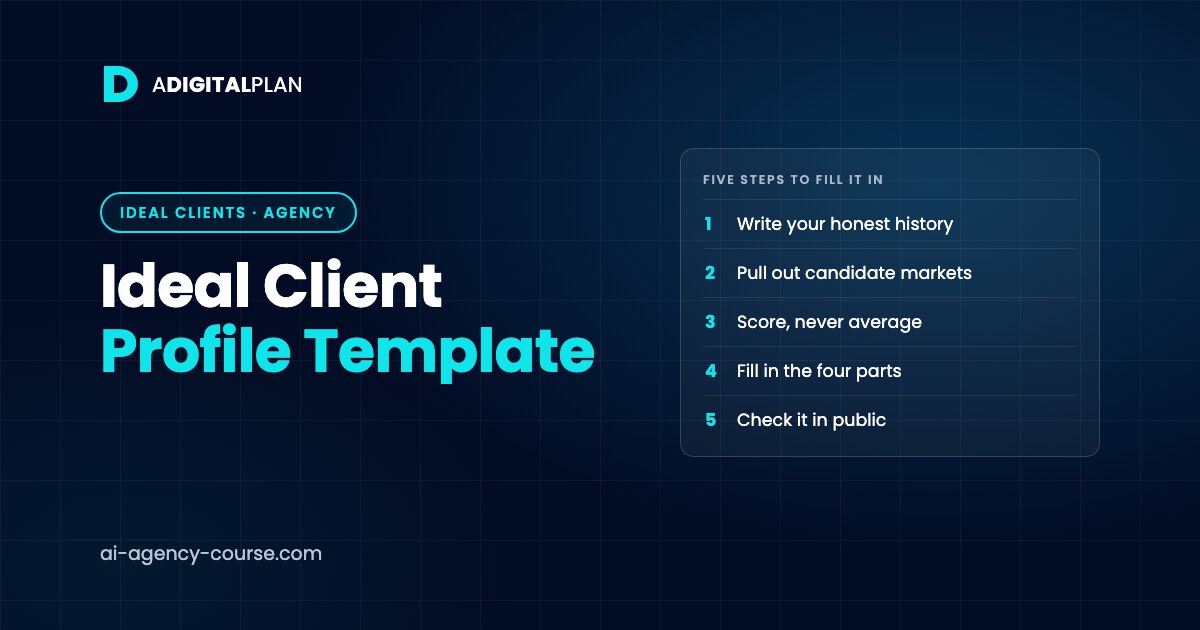
- Write your honest history. Every client, including the ones that ended badly and the favours. Add the freelance work and the jobs before the agency, and the industries you know from outside work. Twenty minutes is enough.
- Pull out candidate markets. Ask Claude for five candidates, each traced to a line you wrote. If your history points nowhere, it should say so rather than invent five sectors.
- Score them, but never average. Score each candidate one to five on six tests: reachable, already spending, something urgent, provable in ninety days, a way in, and repeatable. One fatal score on reachability or proof kills a candidate, whatever the total says.
- Choose one and fill in the four parts. Use the prompt below.
- Check it in public. Spend one evening on free public checks before you change your website or headline. Can you find two hundred names?
The prompt for step four, with square brackets for what only you can supply:
I run a [type of agency]. I have chosen this niche: [niche].
Here is my honest work history: [paste your list of clients, jobs and freelance work].

Fill in an ideal client profile with four parts:
1. Market: what observable thing decides who is in it, and where I could list 200 of them without buying data.
2. Trigger: one visible event that makes some of them look this quarter.
3. Their words: phrases they would use for the problem. Only use phrases that appear in my history. Mark anything you are guessing as a guess.
4. Disqualifiers: three signs I could spot from outside that rule a business out.
Then write one sentence on the work I should now turn down.
Do not invent clients, results or figures.
Then run a second check:
Here is my ideal client profile: [paste the profile].
Act as a sceptical reviewer. Which part could not be checked from outside? Which disqualifier would I ignore on a slow month? Rewrite any part that describes a temperament instead of a market.
The full ICP template in the course goes further, with a six-check verification brief and a positioning line,, but these two prompts give you a usable first draft.
Worked example (fictional demo)
Northgate Studio is a fictional two-person social media agency, invented for this example. Its history: one owner spent six years working front of house at independent gyms before starting the agency. Its current clients are a mix of a café, a gym and a law firm.
The filled-in profile looks like this:
- Market: independent gyms and fitness studios with one or two sites, listed on a map search for the owner’s region.
- Trigger: a job advert for a front-desk or membership role, or a second site opening.
- Their words: “members drop off after January”, “nobody books the intro session”. Both came from the owner’s old job, not from Claude.
- Disqualifiers: part of a national chain, no social account posted in six months, membership run entirely through a franchise app.
- Turning down: cafés and professional services, starting now.
Common mistakes
- Writing an age, a job title and a stock photo instead of a market. “Sarah, 34, marketing manager” cannot be checked.
- Letting Claude invent the market’s words. If a phrase did not come from you, a client or a public page, mark it as a guess.
- Averaging the six scores, so a niche you cannot reach wins on enthusiasm.
- Leaving out the disqualifiers, so every enquiry still looks like a fit.
Finish with a market you can name
The free Agency AI Niche & ICP Finder runs this in four short lessons, six prompts and a recorded demo, with a prompt pack and SOP. You finish with five candidates traced to your own history, one chosen marketing agency niche, a verification brief, a four-part ideal client and a positioning line with its no-list. It is also the starting point the free Cold Outreach course assumes you already have.
FAQ
Do I need clients before I fill in an ideal client profile?
No. The template works from your previous jobs, freelance work and the industries you know. Choosing at the start is cheaper than drifting later.
How specific should an agency ideal client profile be?
Specific enough that you could build a list of two hundred named businesses from public sources in an afternoon. If you cannot, the market part is still a preference.
Can Claude write my ideal client profile for me?
Claude can sort, score and pressure-test it. It cannot know what you have actually done, so the history and the final choice have to come from you.